NYSE BPI Update - November 20, 2026
By Chris Rowe ·
Latest Change: A reversal from a bullish X-column to a bearish O-column
Date of Change: Thursday, November 19th
Days in a Column of X's Before Reversal: 8
High-Level Interpretation: Supply is back in control of the stock market.
********
The NYSE BPI, having posted a new O-column (down-column), now says “supply side is back in control of the stock market”.
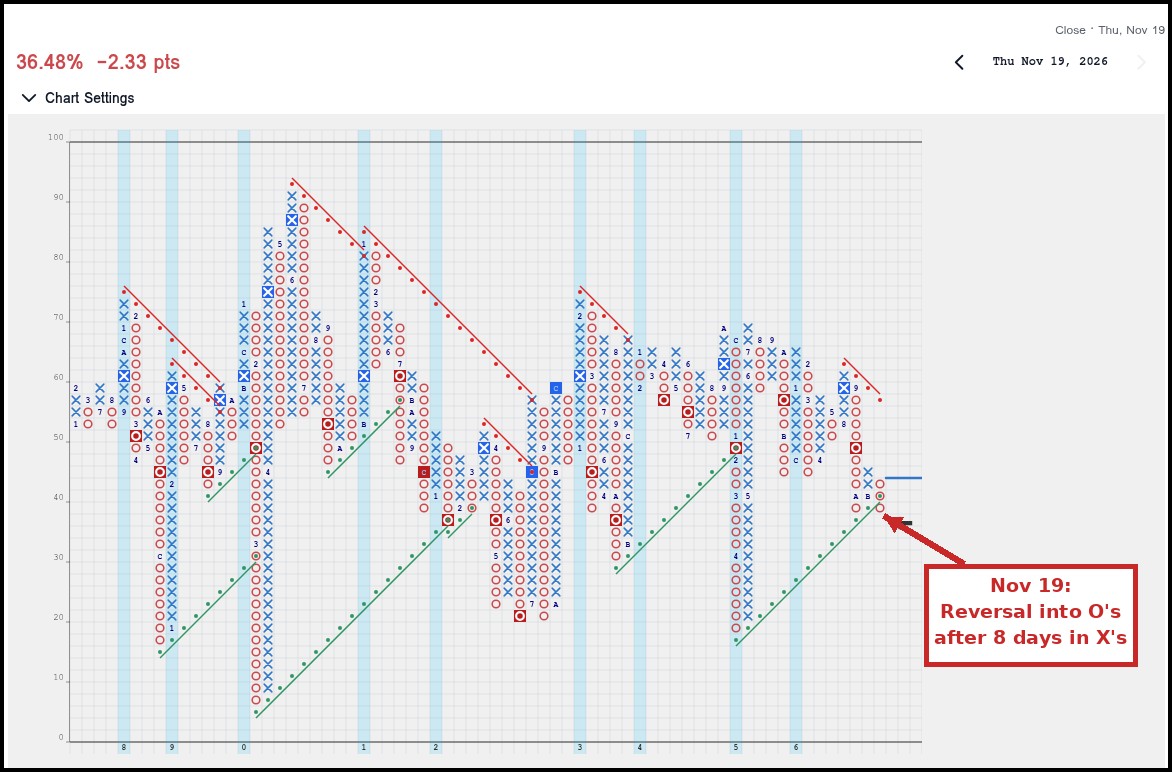
The NYSE BPI had flipped back to an X-column (an up-column) but maintained that for only 8 days. We all had our doubts about the X-column but then again, don’t investors typically have doubts any time an indicator tells us the tide is shifting?
This is a conundrum that I’m happy to address. I’ve read a hundred technical analysis books, written my own and over 1,000 articles about the subject. I learned from the best of them and I’ve noticed one commonality we all tend to agree on and that is: There’s just not that much a trader can do about a “fake out”.
Technical indicators are just indicators, not a money printing machine or crystal ball. They range from fairly useful to extremely useful and the NYSE BPI is the champion of them. And investing models are created around indicators when their signals are added to algorithms that determine what stocks will be bought or held. And in the case of investing models, they’ll rigidly follow rules because they must, in order for the investing model to exist. (For example the 5-Star Model that we provide to members of Sector Focus. It always owns 5 stocks and it outperforms amazingly in the long-term but it will, of course, underperform for certain short-term timeframes, as it mathematically must).
Models and individuals using indicators can not escape “false signals” and I’m not even sure it’s fair to call this a “false signal”. Indicator signals tend to get lumped in with actual false signals, which is when a stock breaks through a significant price point, causing humans and algo-trading-software programs alike to trigger a trade, only to see that stock reverse back in the other direction instead of continuing on in the direction of the price break. THAT is a false signal, or a fakeout, because that’s often done on purpose with the intention of luring investors into a trade, providing an opportunity for the person who caused it to happen. It’s sneaky.
But we still call something like a flip to Xs for a short time, during a very strong selloff like the one we’re seeing lately, a false signal, if it quickly reverses back down by enough to generate a new O-column. It seems to me that “false signal” has negative connotations and suggests an indicator is somehow broken. Yes, people do get mad at a math equation, lol. I’ve seen it many times. But it’s there to help us understand markets clearly.
When it comes to using technical indicators it’s important to not be too rigid, as an investing model would be (it’s literally a robot). The indicator reports on what happened in the stock market - it told us that there was a +6% change in the number of stocks that were on buy signals vs sell signals. Good to know.
Keep in mind the 3 keys to money management, in the order of importance are:
- Risk management
- Allocation
- Timing (and this takes a far third place key, but a key nonetheless).
…Therefore, the timing aspect shouldn’t be that big of a deal anyway, even though it’s certainly important. If you have the first two keys in order then the third one shouldn’t be too stressful.
The primary purpose the NYSE BPI serves is helping us understand the risk in the market. It helps us with our stance in terms of risk which should then be followed by a consideration on how we are positioned - we take the info from the BPI and turn that into an action or a way we position ourselves. Its secondary purpose is to help us with timing, especially for long-term positions and especially when the indicator is in overbought (+70) or oversold (-30) territory.
Back to the “conundrum” that’s typically in the world of investing and trading…
There really isn’t much that we can do about the fact that sometimes the market will shift in ways that causes us to move and then the market shifts back to the way it had been again. And that shouldn't cause us stress but instead we accept it as part of the process. Everyone should develop and refine their own strategies that they are comfortable with, but that tend to work well over time. Some people want to see a stock break out (move above resistance level) by a certain percentage before buying it (stock that has resistance at $10.20, but trader wants to see it close above $10.80 before feeling like that was enough of a breakout for it to confirm that it is in fact likely to continue.) Others want to see the stock stay above $10.20 for a period of time (stock moves to $10.80 but the trader wants to see it hold above $10.80 for 2 days). Most people don’t stick to rules strictly and take it one trade at a time.
The “conundrum” is this: The more confirmation a trader sees from a stock’s (or an index’s) behavior, before buying it, the higher the price of the stock usually has gone. Less risk often means higher probability but lower profit opportunity. And this isn’t a good or bad thing. It’s just something to understand. You should do what you’re comfortable with (as long as your comfort isn’t derived from the wrong thing like “comfort in numbers” or “comfortable holding a declining stock because selling it is admitting the loss”). But it’s okay to require confirmation before it’s your “cup of tea”. Do what you’re comfortable with.
If you’re more aggressive and you get into positions “early”, before seeing much confirmation and follow-through, that’s fine but you have to be as aggressive getting out of it when there’s signs that you’re on the wrong side of the trade (stock shows weak behavior).
Which brings me to my main point in the context of the NYSE BPI’s recent behavior…
If we see the new X-column and we have been witnessing a weak market in a weak time of the year in a weak year (“year-2” in the 4-year presidential election cycle… mid-term year), one might be skeptical about the X-column. Part of the conundrum is that we almost always have a healthy sense of skepticism when we see a new signal, early on. Our minds have been in a different mode and then up pops a signal saying “okay this is over and the new thing seems to be starting”. Yes, “this time was different” but the point remains…
In this type of situation, if we isolate the “market timing” component and forget the risk management and “what” you’re investing in (“allocation”) aspect… when we get a bullish signal, it’s typically best to switch to bullish immediately. I’d say virtually every time. And again, if that signal is quickly followed by a bearish one then okay, it’s annoying but that’s when we flip right back to bearish. No waiting.
There are two camps in this scenario:
- I’ll wait until I see a bit more follow-through (or “confirmation”) before I react to this bullish signal with increased bullish positioning.
- I’ll increase my bullishness in my positioning right away.
Personally, I was not in the #2 camp. The X-column was met with lots of skepticism.
The #1 group is my focus today. In terms of the recent X-column flip, some would feel they should wait for some follow-through before adjusting their stance to one of more bullishness. And that’s fine. But, considering the market environment, the right stance would be to wait for significant confirmation and this might have required a lot of time.
The problem that the #1 group could have been faced with is they wait and then they see higher prices (which is always accompanied by bullish financial media with bullish comments and therefore bullish influence etc.). This causes fear of missing out. This often leads to people not waiting for enough confirmation and follow-through. They set out with good intentions, to be responsible and willingness to give up some upside in exchange for perhaps a higher probability outcome. But they feel like they’re missing the big move and after waiting for a bit more upside, they then get in.
And this is the difference that I’m talking about. One should resist that urge to say “okay that’s enough, let’s just get in before we miss it”. Because, especially in a market like this one, the worst thing you can do is wait for only a little bit of follow-through because if we’re going to go lower then you’ve just bought in at even higher prices and possibly right before the reversal lower.
So the lesson is that one must determine if they’re going to be truly more conservative or aggressive and then be that.
If you’re going to get in, then get the heck in right away when you see that X-column. The X-column is created because there actually was confirmation in the form of a significant % of stocks moving to buy signals. The BPI doesn’t really need confirmation - the signal is the confirmation. The whole point of viewing it on a P&F chart (Xs and Os) is that it takes a lot for it to flip.
So if you’re going to do it, then get in and then just accept the fact that it may flip back to Os quickly and then when that happens, you need to get your butt back to the less-bullish (or bearish) stance that you had before the X-column appeared. In fast, out fast - THAT is who you are, how you roll, how you trade. You’re the one who gets in at the great price and sells at the great price but you’re also the one who will be faced with a lot more “false signals”.
The “other person” is the one who doesn’t want to deal with jumping in and out or who isn’t as accepting of taking losses (a natural and required part of trading - if you aren’t comfortable with losses then you’re not a trader - stop trying to be one and just invest, which is longer-term).
Neither approach is right or wrong. Both can be wildly successful. But it’s unreasonable and unrealistic to try and be the more conservative person who looks for confirmation but also feels stressed about buying after a significant move up or (and this is the tougher one) selling only after a significant move lower, which wipes away profits you had on the table or which means bigger losses when it happens below your purchase price.
You can’t have both. You can try to have both and I’d estimate about 99% of us do try to have both. So should you try to go against human nature and change yourself in a way that 1% of people are able to? Ha. Maybe but I find it best to admit we aren’t superhuman and instead do what we can to stay true to our investment personality, pick a lane, be #1 or #2 and since we’re going to try to be both, I’d say to figure out how to try and be both but just a little bit.
Also, you can get away with being both if you’re willing to pay close attention and willing to trade based on a lot of evidence and be less passive. You can take everything into consideration - the sector’s strength, the sector’s demand/supply situation, the stock’s relative strength, the stock’s chart formation and chart patterns (such as the candlestick patterns), the cycles and seasonality, the insider or unusual options activity… all the things!
That’s what we do here at True Market Insiders/Sector Edge. It’s actually pretty easy to do since the rules don’t change and we can quickly understand the market by looking at the website for 3 minutes.
Supply is in control right now - says the NYSE BPI. We hope to see a continued move lower so that NYSE BPI can get down as low as possible. This creates a very low risk environment, but only after the indicator reverses back to Xs after being in “oversold territory” (under 30).
We are sitting on the edge of our seat with popcorn waiting for that glorious moment.
Chris Rowe
Founder, True Market Insiders